ABOUT BREPOCITINIB
Priovant’s lead investigational medicine is brepocitinib, a dual TYK2/JAK1 inhibitor administered as a once-daily oral therapy. Brepocitinib is in late-stage development for several highly morbid autoimmune diseases with few or no approved targeted therapies, across which it has generated multiple successful Phase 2 and Phase 3 results.
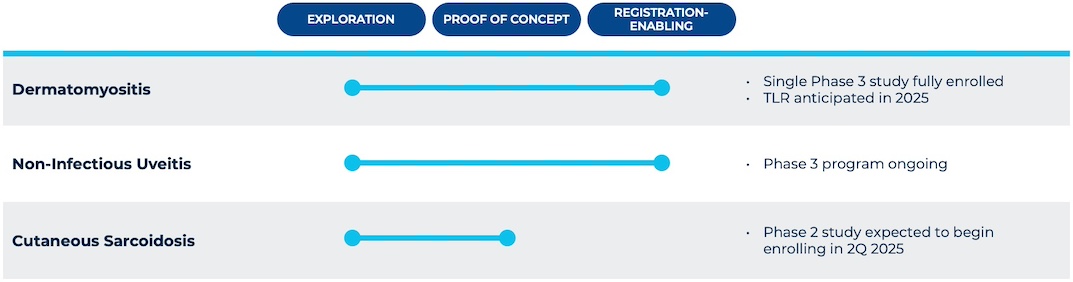
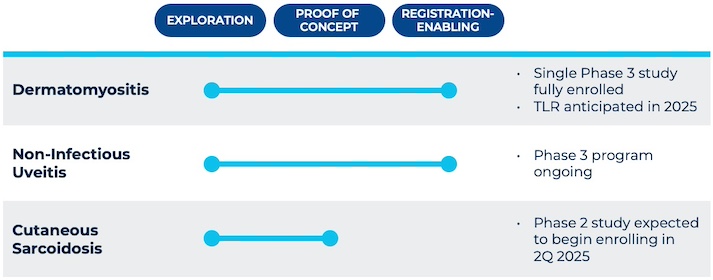
Priovant's New Drug Application (NDA) for brepocitinib in dermatomyositis (DM) was recently accepted by FDA with Priority Review, and Priovant expects to launch the drug in the United States at the end of September 2026. The NDA filing came on the back of successful results from the Phase 3 VALOR study—the first ever positive 52-week placebo-controlled trial in DM—which demonstrated clinically meaningful and statistically significant improvement on measures of global myositis response, muscle disease, skin disease, and steroid-sparing.
Priovant is also evaluating brepocitinib in a Phase 3 study in non-infectious uveitis (NIU), with results expected in the second half of 2026, and in a Phase 2/3 study in lichen planopilaris (LPP). Priovant plans to commence a Phase 3 study of brepocitinib in cutaneous sarcoidosis (CS) in 2026, following positive data from the Phase 2 BEACON study.
Brepocitinib’s safety database across all evaluated indications includes over 2,000 exposed subjects and patients and suggests a safety profile similar to that of approved JAK inhibitors. In the Phase 3 VALOR study of brepocitinib in DM, adverse events of special interest (including malignancy, thromboembolic events, and cardiovascular events) did not occur with greater frequency in the brepocitinib 30 mg arm than in the placebo arm over 52 weeks of double-blind treatment.
Priovant is also exploring additional potential indications with high unmet need and for which dual inhibition of JAK1 and TYK2 is expected to provide differentiated benefit.
ABOUT DERMATOMYOSITIS
Dermatomyositis (DM) is a multi-organ idiopathic inflammatory condition that affects approximately 50,000 adults in the United States. DM is characterized by debilitating muscle weakness and skin lesions. DM-related muscle weakness causes significant impairment to daily living activities, such as walking up stairs, carrying groceries, and getting dressed. Dermatomyositis rashes often affect large portions of the body, including the face and scalp, and are associated with itch, pain, and permanent damage. No targeted therapies are approved for DM, and a majority of patients require chronic high-dose oral corticosteroids, which carry significant adverse health effects. DM patients experience increased risk of interstitial lung disease, malignancy, and heart failure, which contribute to a significant five-year mortality rate, with estimates ranging from 15% to 40%.
To learn more about dermatomyositis and hear real stories from patients and providers, visit dermatomyositis.com.
ABOUT NON-INFECTIOUS UVEITIS
Non-infectious uveitis (NIU) is a vision-threatening ocular autoimmune disease. NIU is the fourth-leading cause of blindness among the working age population in the developed world and is responsible for 10% of cases of blindness in the United States. There is only one approved non-steroidal therapy for NIU, which has limited efficacy, with more than 50% of patients failing to achieve disease remission. Even among patients whose ocular inflammation is effectively managed, serious sequelae of NIU, like macular edema, remain a major challenge for patients and physicians.